This haunting project was written and composed in order to explain the life and legacy of Frederick Pettengill, including his continued presence on the Bates College campus and how it manifests itself. To accomplish this, the project is divided into 5 sections: Introduction, Context, Process, Interpretation, and Social Media.
The introduction, which you are currently reading, will broadly explain what you should expect to encounter in this project. By the end of the five individually explained sections, you should have a general understanding of the purpose of the project.
The context section that follows contains a detailed biography of Frederick “Pat” Pettengill’s life. Covering from his birth, through his education at Bates College and the University of Pennsylvania, followed by his experience in the military during World War II and the Korean War, his marriage to Ursula Prater, and finally, some notable words said about him in important moments in his life that shed light on his character.
Next is the process section, which contains a recount of my experience compiling this project, what information I came across, and how it helped form the final product. By explaining my thought process as I underwent creating this haunting, it should reveal why certain information is included or excluded and what or why it contributes to the haunting in a positive way.
Subsequently is the interpretation section, the most important part of the haunting. Its importance lies in its elaboration on the varying societal implications of the haunting and my thoughts as I created it. It brings in primary sources relating to Frederick and Ursula Pettengill as well as works by Edina Harbinja and Avery Gordon to explain the societal relevance of technological haunting and the manner in which haunting can indicate not only ghosts and ghouls but forgotten systems and institutions. By the end of this section, you will have a better understanding of my own views on the matter as well as how everything comes together and, well, matters.
Lastly, is the social media section, which, in other words, is the haunting itself: a Twitter account. For the haunting, I made a Twitter account under Frederick Pettengill’s name, including pictures from throughout his life, quotes from people in his life, and other relevant comments. In some instances “his” tweets are not done from his perspective and are instead from others’. These tweets are quotes from his coworkers and friends said during speeches that shed light on the type of person he is.
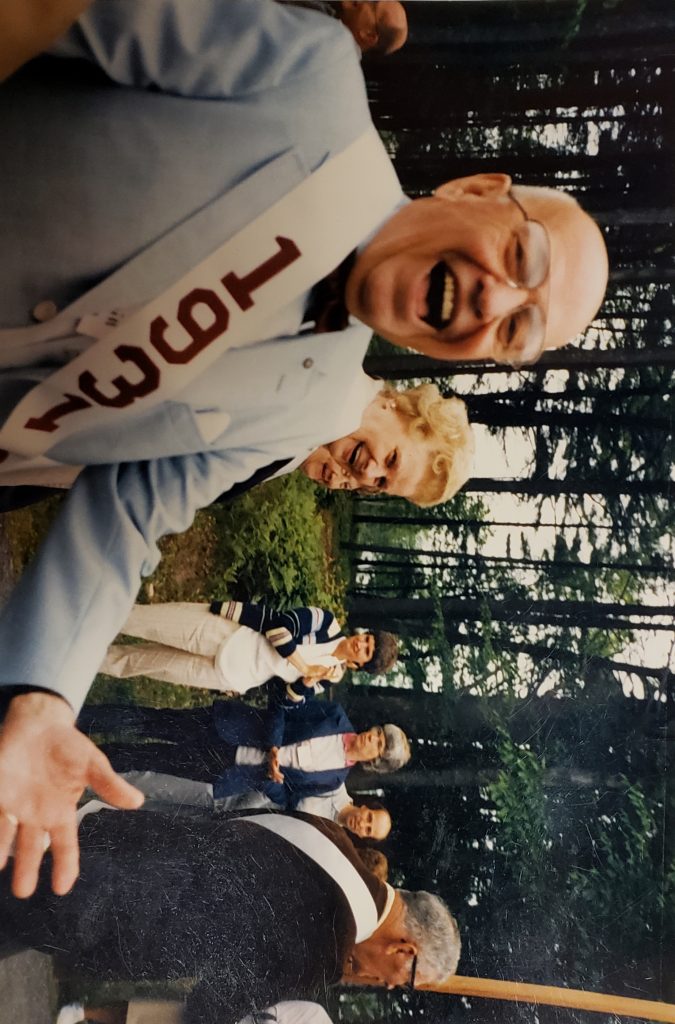
Frederick “Pat” Pettengill was born August 29, 1909, in Pembroke, New Hampshire, and grew up with an avid fascination with theatre. In 1923 when he attended grammar school, he played “December” in “A Pageant of the Seasons,” and further explored his interest in theatre throughout his life, even getting his Broadway “Dinner At Eight” playbill signed by all the lead actors and actresses. Long before that, however, Pettengill attended Bates College, graduating in the class of 1931. During his time at Bates, he notably did not appear to participate in any theatre, however, he did write for the Bates Student (the school newspaper), and ran in track and field. After graduating in 1931, he worked for a YMCA in Keene, New Hampshire, and was then hired by the Bordentown Military Academy to teach history and economics. He went on to earn his master’s degree at the University of Pennsylvania in 1940.
Like most men of the time, Pettengill joined the military to fight in World War II, serving in the United States Air Force in the Pacific theater and later in the Korean War. He retired from military duty with the esteemed rank of lieutenant colonel, however, he was not done working yet. In 1946 he began working at Syracuse University as a veterans’ housing manager and later as the resident administrator for the university’s graduate centers.
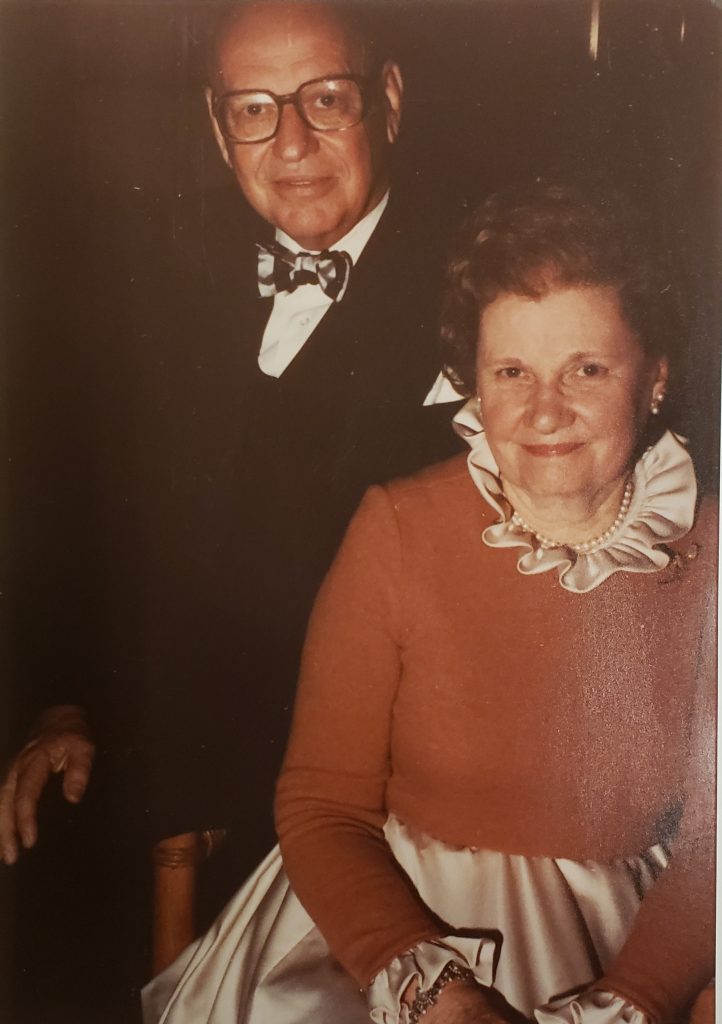
While he had remained unmarried for the first 42 years of his life, a fairly rare occurrence for the time, on June 21, 1952, he married Ursula Prater, with whom he remained married until his death in 1986.
However, much occurred between the time of his marriage and his unfortunate passing, much of which truly shines a light on the man Pat Pettengill was. In a letter addressing an audience celebrating the 25th anniversary of a Syracuse graduate center, a friend of Pettengill stated, “Seriously, though, a lot of the success of the past 25 years, of course, was due to the untiring devotion of our dear friend Pat Pettengill. Pat with his soft and quiet voice and his unhurried manner was always there to soothe ruffled feathers and make sure our operation ran as smoothly and economically as possible” (“Dear Brad” 1978). During the same celebration, another speaker told a humorous and heartwarming story about Pettengill, telling the audience, “You know, a lot of people think President Carter invented the three-martini-lunch. That just isn’t true. Economy minded Pat invented the three-martini lunch. Only it didn’t start off as three martinis: it started off as three KOOL-ADES. Pat used to let us buy three KOOL-ADES from the kids at the roadside stand along Route 26 on our way down to Endicott” (“Dear Brad” 1978). In another speech, a good friend and coworker of Pettengill said, “Of course, as we all know, Pat is a real gourmet. He knows where all the best eating places are in the whole Southern Tier. For really special occasions he would take us to the McDonalds over in Binghamton” (Howard Card 1978). The unwavering tone of endearment with which these speakers regard Pettengilll emphasizes the kind and gentle nature of this humble man.
The most difficult aspect of this project was actually just finding a person to do the presentation on. I was not interested in doing someone like Muskie because I assumed others would already have chosen him, and I didn’t want to research someone fairly insignificant or who lacked accessible information. Pettengill ultimately felt like the appropriate choice given those criteria, especially since we take the class in the building named after him.
Finding information about Frederick Pettengill was even easier than I expected, despite being one of the most common names heard on campus. I began simply by walking through Pettengill Hall after class, looking for plaques, nameplates, or maybe a brochure that might tell me some kind of information about him. Unfortunately, there is very little information about Pettengill in Pettengill Hall, which is not super surprising. After failing to find anything there, I looked online and found several substantially sized sources that looked promising. Among them were yearly compilations of The Bates Student from the 1929-1930 and 1930-1931 school years, a yearbook for the graduating class of 1931, and the largest, The Ursula and Frederick Pettengill Papers. While the prior three sources provided small glimpses into Pettengill’s life at Bates, the latter was a massive compilation of lifetime accomplishments, awards, correspondences, and much more. The Pettengill Papers, however, required that I go to the Muskie Archives to view more than simply a summary of its contents.
The Pettengill Papers contained memorabilia from throughout his life, including playbills, graduation certificates from grammar school and high school, correspondences with colleagues and friends, letters from Bates (mostly thanking him for his generous donations), speech transcripts referring to him, and a massive one hundred page scrapbook made by his wife, Ursula. The Papers shed light on the many lives he affected through his dedication to serving others and put in perspective just how many awards one person can receive. Seriously. He got so many.
Nonetheless, after spending hours pouring over the Pettengill Papers, I was ready to begin thinking about potential haunting ideas. Initially, I looked into putting together a timeline or short video, however, the details of his life in terms of dates are very unclear, and a video is a substantial commitment. I ultimately decided to make a Twitter account to show more pictures of him and shed light on who he seemed to be.
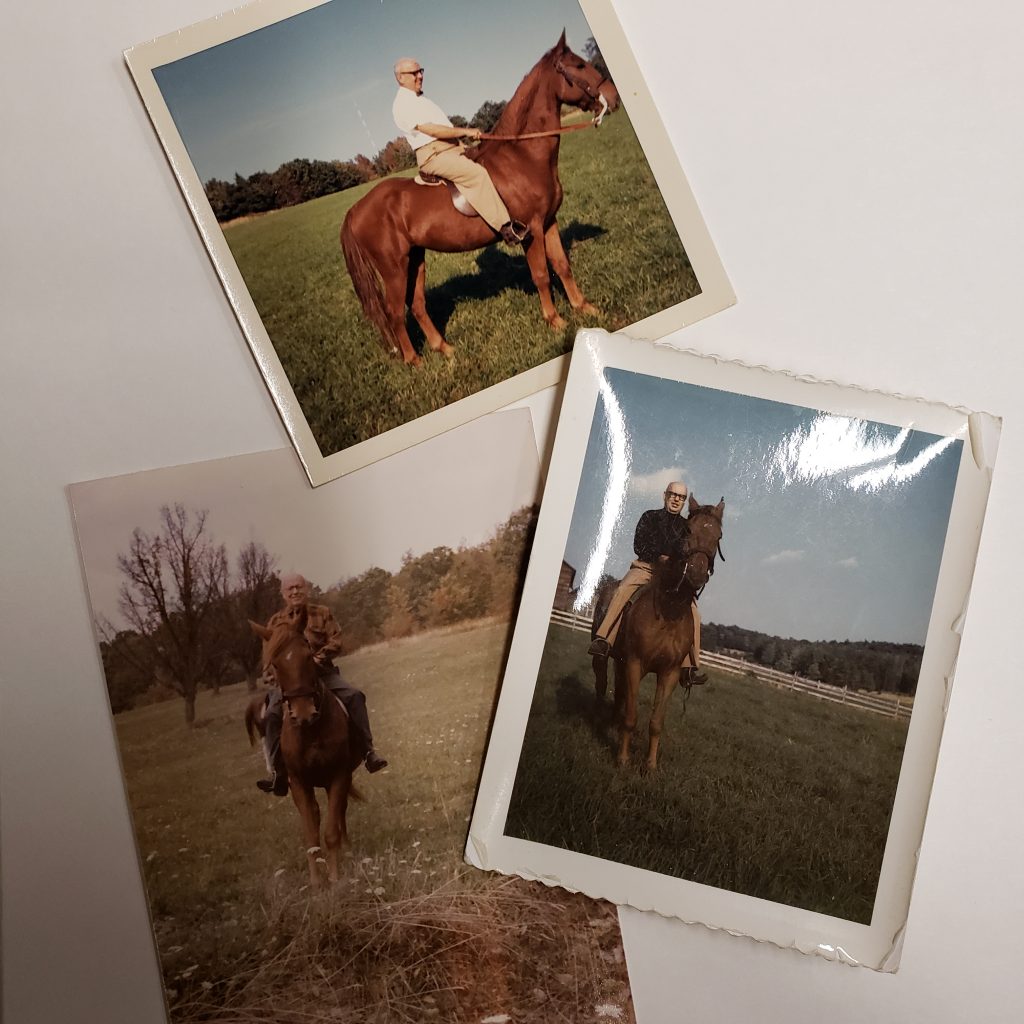
I did struggle to put it all together, however, as I couldn’t find any information on what he liked to do other than ride horses
(it really seemed like the only thing that came up as a hobby), but I ended up going through the scrapbook one more time and found that he loved his dog, Dukey, and frequently had students over to his home to talk. After incorporating those things into the Twitter account, I decided it was ready.
The world has entered the age of Information, which, as it implies, is characterized by the incredible boom in information acquisition and sharing around the world. Most information is freely available on the internet. However, some companies collect private information and keep it secret for their own use. Companies collect data through phone microphones, Alexas, televisions, online purchase trends, and browser search history. In fact, after researching the history of Frederick Pettengill for this essay I was faced with widespread advertisements for Ancestry.com and other historical documentation centered sites. The technological era has also marked significant improvements in our abilities to communicate with one another. As such, word spreads very quickly, especially with social media. Oftentimes the ideas that spread through social media, especially as they relate to the #MeToo movement and Black Lives Matter, have resulted in the stigmatization of some groups on a larger scale, usually for the better, but sometimes for the worse. Such was the case with Pettengill Hall at Bates College, “named in honor of the late Frederick B. “Pat” Pettengill” (N.A. 2017). When I began doing research on Pat Pettengill, I had already convinced myself that he would likely be a racist, sexist man because he was born in the early 20th century. I reached this conclusion because that is what has become the standard of wealthy white men born in the early 1900s on the internet. These preconceptions were proved to be wrong, however, nonetheless I spent hours looking for negative attributes. As such, I argue that when reading information, the data should be interpreted at face value without the influence of preconceived ideas.
To explain my point, it is necessary to know some information about Pat Pettengill. He was born on August 29, 1909, in Pembroke, New Hampshire, and grew up an avid fan of theater. He later went to Bates College, participating in debate, writing for The Bates Student, and running track, until he graduated with the class of 1931. He went on to work “for the YMCA in Keene, New Hampshire and Red Bank, New Jersey, and taught history and economics at Bordentown Military Academy, where he also managed the athletics program” (Stefko, 2011). In 1952 he married Ursula Prater, with whom he remained until his death in 1987. Nonetheless, throughout his time at Syracuse, “Pat Pettengill remained dedicated to Bates, serving as the College Club president and recruiting students” (Stefko, 2011). In fact, he was known as “Mr. Bates” among many, and by the time of his death, he had donated more than 100,000 dollars to Bates College (Pettengill Papers, 1987).
As mentioned, I expected Pat to be a prejudiced man, and because of these expectations, I unjustifiably tried to find negative things about him. Not only that, when I failed to find what I was looking for, I assumed he simply chose to omit evidence of such from the papers given to Bates College. Pettengill being a wealthy white male living throughout the 20th century led me to presume that he held racist or sexist beliefs. To be blunt, I had no reason to believe he would be a bad person. Contrary to my preconceptions, there is substantial evidence indicating his beliefs fell on the polar opposite side of the spectrum. A letter written to him by Howard Card, one of his coworkers at Syracuse, indicated that
Pettengill helped pay for the tuition of a black student who could not afford to pay his dues.
In addition, part of a scrapbook made by Ursula mentioned that a Chinese exchange student would come to his home frequently simply to visit with Pat and Ursula. She wrote, “Pat was always looking out for the students… they were always welcome in his office or his home. Or should I say, ‘Looking for him!’” (Pettengill Papers, 1974). Further, both he and Ursula were given Paul Harris Fellows, a title given to those who donate and volunteer a significant amount with a multinational organization dedicated to unraveling racist beliefs. The Pettengills were an accepting, open, and loving couple through and through.
In order to explore the reasons why I had the preconceptions I did, the concept of “haunting” must be explained. Haunting is most often associated with ghosts in a terrifying or spooky sense as the words pertain to monsters, demons, or ghosts. However, in the introduction to Ghostly Matters, Avery Gordon explains her own interpretation of the term “haunting.” She touches on the necessity to comprehend modern forms of systematic racial, political, and social abuse and their impacts on people, and develops ways to write about the lingering damage caused by “historical alternatives” to modern systems of power. To accomplish this, Gordon analyses “haunting,” describing it as “a way in which abusive systems of power make themselves known and their impacts felt in everyday life, especially when they are supposedly over and done with” (Gordon 2). Haunting, Gordon indicates, is the way in which we are alerted to the continued presence of societal abuses and tragedies we may have thought were long gone. It puts us face to face with “ghosts.” It renders the unseen, seen. Having read this excerpt several months ago, I think that my mind has been keyed to look for the negative implications of historical figures and systems, and how they present themselves in the modern day. As a result, I reached for anything negative I could latch onto.
The gravity of my development of preconceptions can be explained by analyzing Edina Harbinja’s “Post-mortem privacy 2.0: theory, law, and technology,” in which Harbinja unfurls the complexities of post-mortem privacy, explaining its relevance to human autonomy and testamentary freedom. Harbinja defines post-mortem privacy as “the right of a person to preserve and control what becomes of his or her reputation, dignity, integrity, secrets or memory after death” (Harbinja 2). Citing theorists such as Kant and Nissenbaum, Harbinja explains the relationship between privacy and a sense of autonomy. Autonomy is established to be generally agreed upon by western philosophers and theorists as a crucial piece to the puzzles that are social and ethical theories, and Harbinja explains that privacy defines the confines of this autonomy. Although many disagree with the concept of total privacy and autonomy, Harbinja wholeheartedly believes in their significance to society. Like with privacy and autonomy, Harbinja uses the works of theorists and philosophers on testamentary freedom to rationalize her argument that privacy should be respected post-mortem. For example, she quotes social theorist Raz, claiming that “an autonomous person is one who is ‘an author of their own life’” (Harbinja 5). In Harbinja’s work, life is likened to someone’s reputation, and this especially holds true in the Informational Age. By having unreasonable preconceptions about Pettengill even while research, I infringe upon his freedom because I chose to omit the reputation he earned and demonstrates through the papers given to the Muskie Archives.
To summarize, Frederick and Ursula Pettengill were a loving and caring couple that dedicated their lives to serving others and maintained a truly honorable reputation. The manner in which I developed preconceived ideas about them based on generalizing social media-borne tropes is unfair and infringes on their freedom and autonomy.