
Frederick “Pat” Pettengill was born August 29, 1909, in Pembroke, New Hampshire, and grew up with an avid fascination with theatre. In 1923 when he attended grammar school, he played “December” in “A Pageant of the Seasons,” and further explored his interest in theatre throughout his life, even getting his Broadway “Dinner At Eight” playbill signed by all the lead actors and actresses. Long before that, however, Pettengill attended Bates College, graduating in the class of 1931. During his time at Bates, he notably did not appear to participate in any theatre, however, he did write for the Bates Student (the school newspaper), and ran in track and field. After graduating in 1931, he worked for a YMCA in Keene, New Hampshire, and was then hired by the Bordentown Military Academy to teach history and economics. He went on to earn his master’s degree at the University of Pennsylvania in 1940.
Like most men of the time, Pettengill joined the military to fight in World War II, serving in the United States Air Force in the Pacific theater and later in the Korean War. He retired from military duty with the esteemed rank of lieutenant colonel, however, he was not done working yet. In 1946 he began working at Syracuse University as a veterans’ housing manager and later as the resident administrator for the university’s graduate centers.
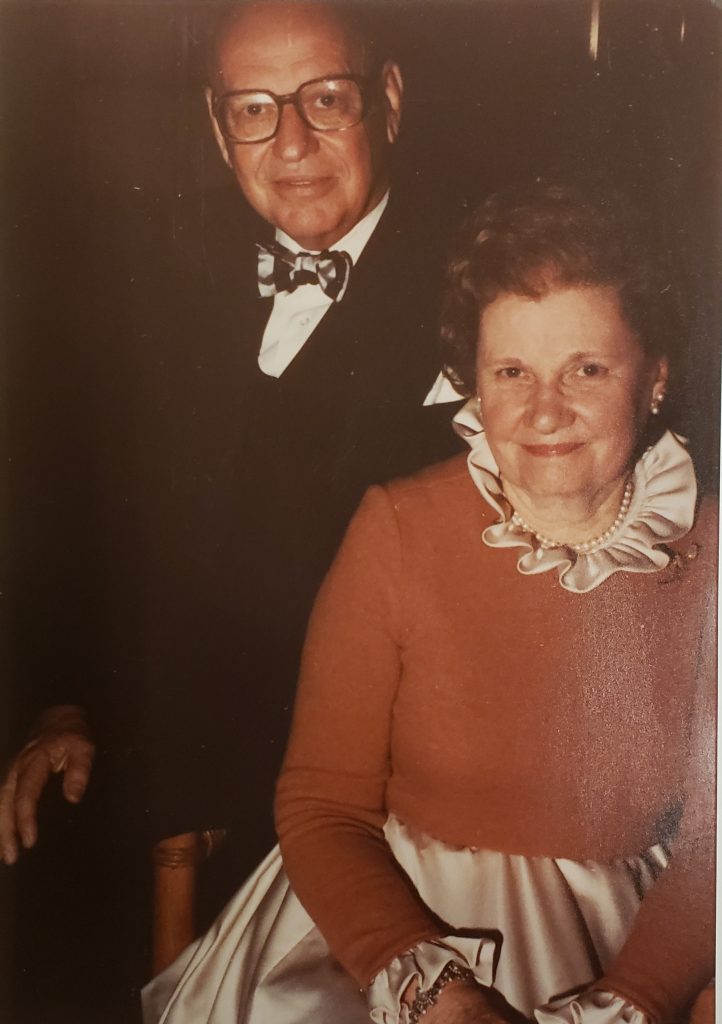
While he had remained unmarried for the first 42 years of his life, a fairly rare occurrence for the time, on June 21, 1952, he married Ursula Prater, with whom he remained married until his death in 1986.
However, much occurred between the time of his marriage and his unfortunate passing, much of which truly shines a light on the man Pat Pettengill was. In a letter addressing an audience celebrating the 25th anniversary of a Syracuse graduate center, a friend of Pettengill stated, “Seriously, though, a lot of the success of the past 25 years, of course, was due to the untiring devotion of our dear friend Pat Pettengill. Pat with his soft and quiet voice and his unhurried manner was always there to soothe ruffled feathers and make sure our operation ran as smoothly and economically as possible” (“Dear Brad” 1978). During the same celebration, another speaker told a humorous and heartwarming story about Pettengill, telling the audience, “You know, a lot of people think President Carter invented the three-martini-lunch. That just isn’t true. Economy minded Pat invented the three-martini lunch. Only it didn’t start off as three martinis: it started off as three KOOL-ADES. Pat used to let us buy three KOOL-ADES from the kids at the roadside stand along Route 26 on our way down to Endicott” (“Dear Brad” 1978). In another speech, a good friend and coworker of Pettengill said, “Of course, as we all know, Pat is a real gourmet. He knows where all the best eating places are in the whole Southern Tier. For really special occasions he would take us to the McDonalds over in Binghamton” (Howard Card 1978). The unwavering tone of endearment with which these speakers regard Pettengilll emphasizes the kind and gentle nature of this humble man.
